We’re about to delve into some science opinions here.
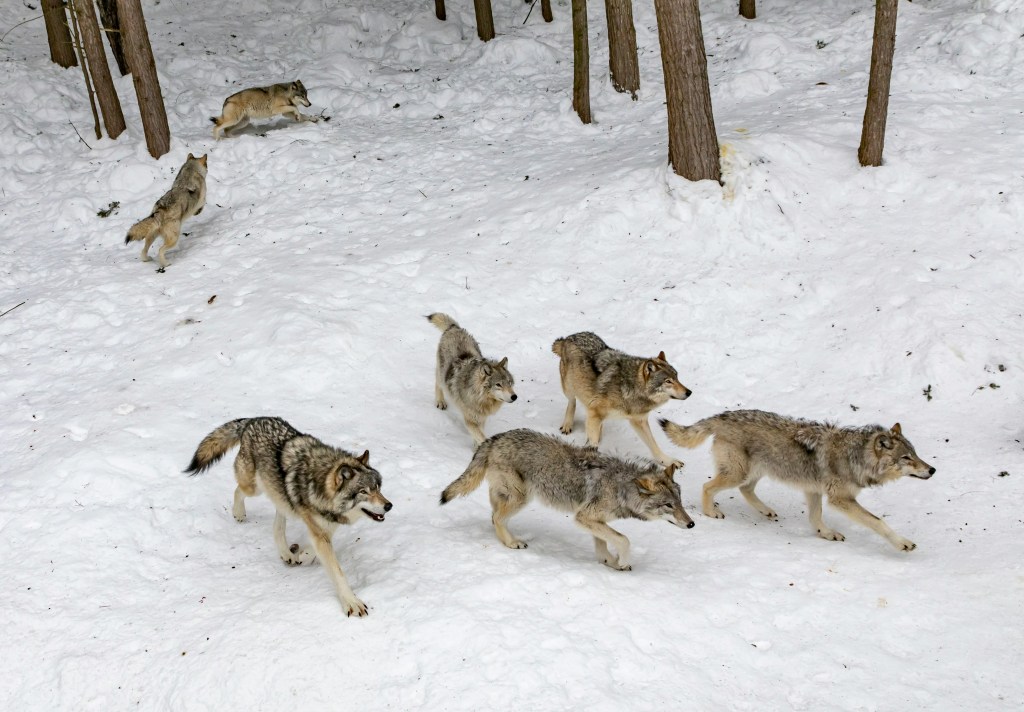
While my interests are widely varied when it comes to the arts, I, like many well-rounded humans, also have interests in other areas like science and technology. Not so much the technology, but for sure when it comes to biology.
When I was young, I had begun my college career on the pre-veterinary medicine track. This is not a shock to anyone who knows me, because I tend to like animals WAY more than humans. I developed an interest in wolves at a young age. When I was in college, I sponsored a wolf from the Sawtooth Pack that was reintroduced into Yellowstone National Park. His name was Amani, and his sponsorship remains something of which I am truly proud.
Their reintroduction into Yellowstone had huge environmental impacts, from regulating prey populations, to restoring ecological balance, increased biodiversity, and healthier ecosystems overall. We see that in the changes in elk behavior. Fewer elk and the wariness exhibited in those that remained caused changes in grazing patterns. Those changes affected vegetation growth. Stabilized vegetation growth along river banks made the rivers more stable by reducing erosion. A more stable river system positively affected the fish, birds and other mammals like beavers. Given that wolves leave carcasses behind to be eaten by other predators like bears, eagles, and cougars, those species began to flourish, too. Reintroduction of an apex predator to a system provides much needed balance. Given that wolves were hunted out of existence in Yellowstone, as humans we had a duty to fix what we broke.
Which brings me to Romulus, Remus, and Khaleesi, the “dire wolves” who were recently “de-extincted.” If my quotations are of any significance to you, reader, you’ll know exactly where I fall on the spectrum of people who think this was a wise or even good decision moving forward.
First, let’s talk about the “dire wolf” and “de-extincted” phrases. The DNA that was manipulated in this instance came from gray wolves. Gray wolves share 99.5% of their DNA with dire wolves. That .5% seems small, but that leaves something like 2 billion pieces of DNA unaccounted for. Scientists chose just 20 changes in 14 of those genes to create what amounts to a designer gray wolf with dire wolf traits. That’s not the same as a dire wolf, no matter how much you want it to be.
Second, let’s talk about why dire wolves no longer exist. They were a predator that lived during the ice age. Their existence was wiped out by climate change. That change in climate shrunk their food supply. Their dwindling food supply put them in direct competition for food by other large predators. The birth of new canids, like the gray wolf, also caused their numbers to dwindle because they couldn’t mate with them. Life did what life does and they, sadly, perished.
So, how does this differ from the reintroduction of gray wolves? First, no one created a new species or one with specific genes expressed that weren’t prior. They simply moved a pack from Canada to another place that shared the same climate, wildlife, and flora that we knew they already lived in. A reintroduction differs vastly from what is being attempted here with the “dire wolves.” Given what we know of how that reintroduction changed things in Yellowstone with KNOWN variables, what does that say for these hybrid wolves whose variables aren’t known?
We can make highly educated guesses about these designer wolves’ environment and food sources and how they may change, but we can’t be 100% sure those guesses are correct. We’re literally playing in the genetic sandbox here. Forgive me, but I believe there was a movie made about that level of irresponsibility a couple decades ago. The theme of that movie was stated in one line: “…your scientists were so preoccupied with whether or not they could that they didn’t stop to think if they should.” There could be unforeseen consequences to this choice in genetic manipulation. Even placing them on their own land may not be enough to sustain these three wolves’ lives. We have no idea how their existence will change the ecosystem in which they live. And, before we even know what the consequences of such science are, Colossal, the company that created the wolves, is working to bring back woolly mammoths, dodo birds, and Tasmanian tigers. Just the thought that scientists think they can control any aspect of this “experiment” is colossal arrogance, in my opinion.
Now, don’t get me wrong. The science involved here is useful for animals who are endangered like red wolves. I don’t have a problem with conservation efforts that fix what we as humans destroyed out of hubris, in the name of development, or just plain stupidity. However, I approach this level of gene manipulation with a great deal of caution and worry. Even though we know the science of DNA has been around forever, it is still a relatively young and burgeoning science . We didn’t start using it to solve crimes until 1986 in the UK and 1987 in the USA. It is advancing every day and scientists are making breakthroughs at breakneck speed.
However, much like Ian Malcolm, I believe that life finds a way. It is the height of human arrogance to think we are in control when it comes to many things, and I think these wolves are a good example. Colossal believes they have de-extincted an animal that nature eradicated. Whatever is on the horizon, for good or ill, we need to tread VERY cautiously. There are consequences to everything. We don’t know the consequences to this.
I guess we do as Ray Arnold advised.
Hold on to our butts.
 The Chronically ill Creative
Leave a comment